
Collagen: Structure and Types
Collagen is the most abundant protein in the body, making up one-third of total protein content in mammals (Tarnutzer et al., 2023). It plays a crucial role in connecting biological structures and serves as the main structural protein in skin, tendons, and bone (Wang, 2021).
The human body contains around 28 different types of collagen (Shahrajabian et al., 2024). Types I, II, and III are the three main types used in supplements.
Collagen type I makes up 90% of the body’s collagen and is the main component of teeth, bone, skin, tendons, blood vessels, lungs, and heart. It’s primarily found in marine collagen supplements.
Collagen type II is abundant in cartilage and is linked to diseases such as skeletal dysplasias, rheumatoid arthritis, and osteoarthritis. It’s derived from chicken and bovine sources (Wang 2021).
Collagen type III is the second most abundant collagen. It’s widely distributed in connective tissues, including the vascular system and internal organs, and plays important roles in cardiovascular development and wound healing (Sun et al., 2025).
Both collagen I and III are significant in fibroblast activation. A mixture of these two types can be obtained from porcine and bovine sources (Sun et al., 2025; Wang, 2021).
Collagen Supplements for Skin: Examining the Anti-Ageing Claims
A 12-week randomised, placebo-controlled study of 72 women aged 35+ showed that daily supplementation with collagen peptides (2.5g) combined with vitamin C, zinc, and biotin significantly improved skin hydration, elasticity, roughness, and density compared to placebo. These benefits were sustained for 4 weeks after stopping supplementation, with no adverse effects reported. It’s important to note that the authors of this study were working on a drinkable nutraceutical called ELASTEN®. The authors declared no conflict of interest. “The sponsor had no influence on execution, analysis and interpretation of the data.” (Bolke et al., 2019). Nevertheless, the study states that it was funded by Quiris Healthcare (Germany), a company which markets this particular supplement.
Another study – this time 12-week randomized, double-blind, placebo-controlled study of 64 participants found that daily supplementation with 1000 mg of low-molecular-weight collagen peptide significantly improved: skin hydration (significantly higher after 6 and 12 weeks compared to placebo), wrinkles (visual scores and three wrinkling parameters significantly improved after 12 weeks), skin elasticity – two out of three parameters significantly higher than placebo after 12 weeks. The supplement was well-tolerated with no adverse effects reported during the study. And once again, authors declared no conflict of interest and no external funding, meaning that the authors claim they did not receive a separate research grant (e.g. from government or independent bodies) to perform the trial (Kim et al., 2019). However, the material tested — the collagen peptide — was provided by a private company (Newtree). Supplying the investigational product counts as a kind of support, even if defined as “no external funding.”The authors declare “no conflicts,” but affiliation with the supplier of the product can still represent a potential source of bias.
And one more study that I wanted to mention is a 12-week randomised, triple-blind, placebo-controlled, parallel study on women aged 45-60. That study have found that hydrolyzed marine collagen marketed as Vinh Wellness Collagen (VWC), which is produced by Vinh Hoan Corporation, supplementation led to: 35% reduction in wrinkle score after 12 weeks, 24% greater wrinkle reduction compared to placebo, 20-10% improvement in cheek skin elasticity for women aged 45-54, self-reported improvements in overall skin score (9%), wrinkles (15%), elasticity (23%), hydration (14%), radiance (22%), and firmness (25%). The supplement was safe and well-tolerated with no adverse effects (Evans et al., 2021). The authors do not appear to declare a “no conflict of interest” statement: the publicly available funding information clearly indicates Vinh Hoan Corporation supported the study.
In September 2025, a meta-analysis on Effects of Collagen Supplements on Skin Ageing: A Systematic Review and Meta-Analysis of Randomised Controlled Trials was published in The American Journal of Medicine. This meta-analysis examined 23 randomised controlled trials and found that collagen supplements appeared to improve skin hydration, elasticity, and wrinkles overall. However, studies without pharmaceutical company funding showed no significant effects. High-quality studies revealed no significant improvements, while low-quality studies showed some benefits. The researchers concluded there is currently no clinical evidence to support using collagen supplements to prevent or treat skin ageing (Myung et al., 2025).
Effects of Collagen on Joint and Bone Health
When I was growing up, I heard a lot about the benefits of gelatin for joint health. When I had a bone injury, everyone recommended eating extra jelly or even taking supplements. And yes, many studies have been done in that area.
Arguments presented in Review of the Effects of Collagen Treatment in Clinical Studies (Wang, 2021) in favour of collagen supplementation for joints and bones:
- Sarcopenia management: Collagen supplements are effective in improving symptoms of sarcopenia (age-related muscle loss). Lifestyle interventions, including nutritional supplements like collagen, can help manage this condition.
- Osteoarthritis treatment: Collagen is a good treatment candidate for osteoarthritis due to its safety and clinical evidence. Both collagen hydrolysates and native collagen are effective in reducing osteoarthritis pain in animal models and human clinical trials.
- Wound healing and injury recovery: Oral collagen administration is an efficient treatment for wound healing, making it valuable for those who have suffered from fractures and contusions caused by accidents.
- Addresses age-related decline: Ageing leads to loss of muscle and bone mass, causing conditions like sarcopenia, osteopenia, and osteoporosis. Early diagnosis and lifestyle interventions, including collagen supplementation, can improve patient prognosis.
Understanding Collagen Breakdown and Synthesis
About four years ago, my biochemistry professor prepared a presentation concerning the different types of collagen available commercially at that time. Believe it or not, back then, collagen was mostly considered a supplement for reinforcing bones and joints, and wasn’t known so much because of the oral supplementation’s impact on skin.
Obviously, new studies have been conducted since then. We have more evidence and more advanced technologies to detect the impact of substances on our physiology.
Nevertheless, what my professor told us four years ago is still accurate and was basically this:
When you consume collagen (e.g., in powder or capsules), it does not reach the skin, joints, or cartilage intact.
In the digestive tract, collagen is broken down by digestive enzymes into:
- amino acids (90%) (glycine, proline, hydroxyproline, hydroxylysine) and many more
- collagen peptides (10%) (short protein fragments).
These molecules are absorbed into the bloodstream, and the body uses them in the same way as amino acids from other protein sources—there is no “memory” that they came from collagen.
Collagen synthesis:
For the body to produce collagen itself, the following are needed: appropriate amino acids (glycine, proline, lysine), hydroxylating enzymes (proline and lysine hydroxylase), vitamin C as a cofactor, and other factors (e.g., manganese, iron, copper).
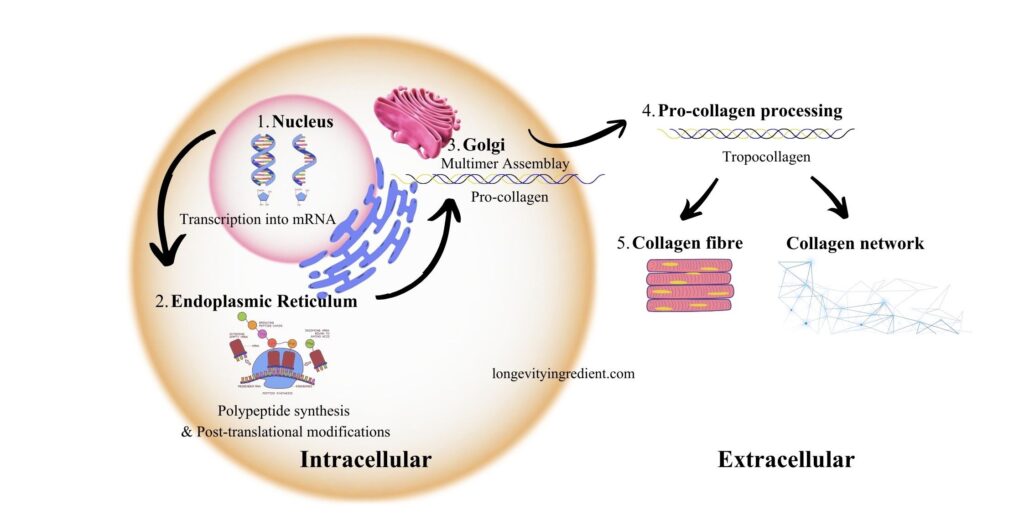
Intracellular Process: Inside the cell, genes are transcribed into mRNA, which is then translated by ribosomes to produce pre-pro-polypeptide chains. In the endoplasmic reticulum (ER), these chains undergo several modifications: the signal peptide is removed, proline and lysine residues are hydroxylated (a process that requires vitamin C), and glycosylation occurs. Three of these modified chains then twist together to form a triple helix structure called pro-collagen. The pro-collagen molecule moves to the Golgi apparatus and is subsequently secreted outside the cell.
Extracellular Process: Once outside the cell, peptidases cleave the terminal ends of pro-collagen to form tropocollagen. Finally, lysyl oxidase creates cross-links between tropocollagen molecules, resulting in the formation of collagen fibrils (Fig.1) (Wu et al., 2023).
It’s very important to note that collagen supplements do not “deliver collagen” to tissues, but at most provide the amino acids needed for its synthesis.
Why Collagen Supplements Might Work: The Signalling Hypothesis
The most plausible explanation for the positive effects shown in studies is:
- Small collagen peptides (such as Pro-Hyp) may act as a signal to fibroblasts, stimulating the production of endogenous collagen (as an indirect effect).
Pro-Hyp, one of the major food-derived collagen peptides, enhances the growth of fibroblasts and synthesis of hyaluronic acid. These observations partially explain the beneficial effects of collagen hydrolysate ingestion on the enhancement of wound healing and improvement in the skin condition. The recent advancement involving liquid chromatography and mass spectrometry coupled with a pre-column derivatisation technique has enabled the identification of food-derived peptides at nanomolar levels in the body post-ingestion of protein hydrolysates (Sato 2017).
The evidence for this mechanism is still limited and inconclusive.
Making an Informed Decision About Collagen Supplementation
With all of this in mind, there is currently no way to confirm whether collagen supplements work as we hope they do. More studies are needed to establish this conclusively.
Meanwhile, is it worth it? Everyone has to answer that question for themselves.
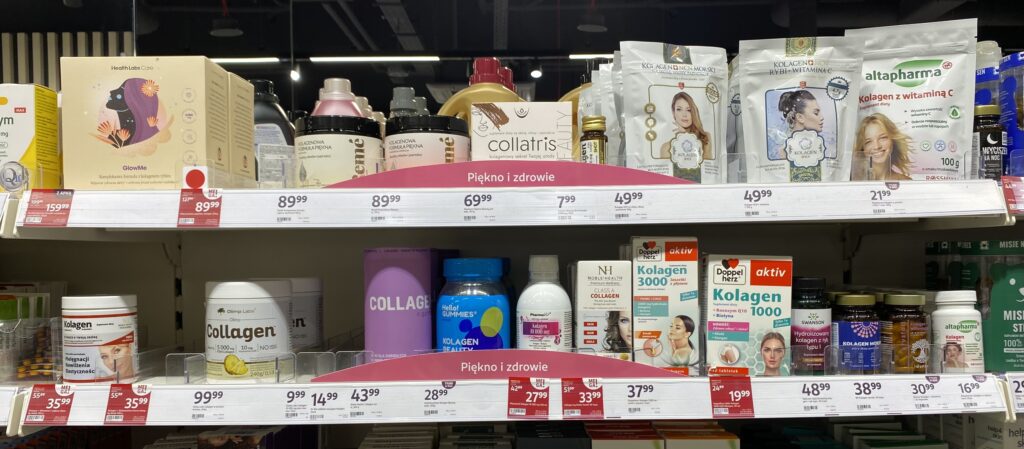
If your answer is yes, consider a proper dosage. Don’t waste money on collagen supplements with minimal collagen content. A 2023 meta-analysis by Pu et al. found that studies claiming beneficial effects used dosages of 2.5–10g of hydrolysed collagen or 2.5–3g of collagen peptides daily (Pu et al., 2023). When choosing supplements, look for products with dosages in this range.
What to Know About Collagen Supplement Safety
Some people may have allergic reactions to collagen supplements. For example, those with shellfish allergies could experience anaphylaxis from marine collagen. Other collagen sources may also pose allergy risks.
Animal-derived collagen carries the risk of disease transmission. Porcine and bovine collagen may transmit illnesses such as bovine spongiform encephalopathy (BSE). For this reason, marine alternatives could be a safer option (Wang 2021).
Overall, the risks are moderate and quite low for marine collagen.
The advantages? They’re certainly potential, but let’s not think of collagen as a miracle solution for skin anti-ageing. What worries me deeply is the observation is that the most significant effects come mainly from studies funded by pharmaceutical companies (Myung et al., 2025).
Final Thoughts
If you’re convinced about taking collagen supplements, go ahead—there will most likely be no harm. At the end of the day, it’s some extra protein. If you have doubts, I understand. Either way, let’s wait for more research, especially independent studies, and stay open-minded.
References
Tarnutzer, K., Siva Sankar, D., Dengjel, J. et al. Collagen constitutes about 12% in females and 17% in males of the total protein in mice. Sci Rep 13, 4490 (2023). https://doi.org/10.1038/s41598-023-31566-z
Wang H. A Review of the Effects of Collagen Treatment in Clinical Studies. Polymers (Basel). 2021 Nov 9;13(22):3868. doi: 10.3390/polym13223868. PMID: 34833168; PMCID: PMC8620403.
Shahrajabian MH, Sun W. Mechanism of Action of Collagen and Epidermal Growth Factor: A Review on Theory and Research Methods. Mini Rev Med Chem. 2024;24(4):453-477. doi: 10.2174/1389557523666230816090054. PMID: 37587815.
Sun, W.; Shahrajabian, M.H.; Ma, K.; Wang, S. Advances in Molecular Function and Recombinant Expression of Human Collagen. Pharmaceuticals 2025, 18, 430. https://doi.org/10.3390/ph18030430
Bolke L, Schlippe G, Gerß J, Voss W. A Collagen Supplement Improves Skin Hydration, Elasticity, Roughness, and Density: Results of a Randomized, Placebo-Controlled, Blind Study. Nutrients. 2019 Oct 17;11(10):2494. doi: 10.3390/nu11102494. PMID: 31627309; PMCID: PMC6835901.
Kim DU, Chung HC, Choi J, Sakai Y, Lee BY. Oral Intake of Low-Molecular-Weight Collagen Peptide Improves Hydration, Elasticity, and Wrinkling in Human Skin: A Randomized, Double-Blind, Placebo-Controlled Study. Nutrients. 2018 Jun 26;10(7):826. doi: 10.3390/nu10070826. PMID: 29949889; PMCID: PMC6073484.
Evans M, Lewis ED, Zakaria N, Pelipyagina T, Guthrie N. A randomized, triple-blind, placebocontrolled, parallel study to evaluate the efficacy of a freshwater marine collagen on skin wrinkles and elasticity. J Cosmet Dermatol. 2021;20:825–834. https://doi.org/10.1111/jocd.13676
Seung-Kwon Myung, Yunseo Park, Effects of Collagen Supplements on Skin Aging: A Systematic Review and Meta-Analysis of Randomized Controlled Trials, The American Journal of Medicine, Volume 138, Issue 9, 2025, Pages 1264-1277, ISSN 0002-9343, https://doi.org/10.1016/j.amjmed.2025.04.034.
Sato K. The presence of food-derived collagen peptides in human body-structure and biological activity. Food Funct. 2017 Dec 13;8(12):4325-4330. doi: 10.1039/c7fo01275f. PMID: 29114654.
Pu SY, Huang YL, Pu CM, Kang YN, Hoang KD, Chen KH, Chen C. Effects of Oral Collagen for Skin Anti-Aging: A Systematic Review and Meta-Analysis. Nutrients. 2023 Apr 26;15(9):2080. doi: 10.3390/nu15092080. PMID: 37432180; PMCID: PMC10180699.
Wu M, Cronin K, Crane JS. Biochemistry, Collagen Synthesis. [Updated 2023 Sep 4]. In: StatPearls [Internet]. Treasure Island (FL): StatPearls Publishing; 2025 Jan-. Available from: https://www.ncbi.nlm.nih.gov/books/NBK507709/
Alcaide-Ruggiero, Lourdes & Molina Hernandez, Veronica & Granados, Mauro & Dominguez Perez, Juan. (2021). Main and Minor Types of Collagens in the Articular Cartilage: The Role of Collagens in Repair Tissue Evaluation in Chondral Defects. International Journal of Molecular Sciences. 22. 13329. 10.3390/ijms222413329.





Be First to Comment