Glucose, dextrose, fructose, galactose, sucrose, lactose, maltose, honey, molasses, fruit juice concentrate, high-fructose corn syrup, glucose syrup, maple syrup, agave syrup, rice syrup, barley malt syrup, cane syrup, cane sugar, beet sugar, coconut sugar, palm sugar, date sugar, brown sugar, raw sugar, invert sugar, evaporated cane juice, cane juice crystals, malt extract, caramel…
These are just a few of the most popular names under which sugar is present in nutrition.
We need glucose in the blood for the organs to function – It’s the ultimate fuel. Nevertheless, the biochemistry of our body is amazing. Even without sugar intake per se, the organism can produce some glucose in biochemical reactions. For example, during an overnight fast, most of your blood glucose is coming from glycogen (a complex form of glucose stored in the liver and muscles), and gluconeogenesis (where glucose is made from certain amino acids, lactate or glycerol), not from your last meal.
I don’t believe in the ketogenic diet (a high-fat, very low-carbohydrate, and moderate-protein dietary approach designed to induce nutritional ketosis (Daley et al., 2026)) being an ultimate cure for all. However, I’m certain that many problems lie in high chronic intake of added sugars (HCIAS).
The Harmful Mechanisms With Sugar As a Culprit
The scientific evidence points to the fact that high intake of added sugars and the associated mechanisms contribute to accelerated ageing. Far more popular are glycation (AGEs) and insulin resistance. Oxidative stress, chronic inflammation, and reduced tissue repair are often cited as separate mechanisms, but they are ultimately closely connected.
The effect of HCIAS seems to be mostly mediated by fructose, targeting the liver first, and then leading to all the following metabolic alterations. The very basic alterations provoked by fructose are increased oxidative stress, glycation, inflammation, dyslipidaemia and insulin resistance. These alterations are also present during the ageing process, and are closely related, one leading to the other (Gatineau et al., 2017).
Most of the studies discussing the pro-ageing impact of glycation focus on skin ageing. It’s widely known that sugar is cross-linking two collagen fibres, making them incapable of undergoing the process of remodelling and reparation. In the excessive presence of sugar, the maintenance of flexible and repairable collagen fibres is challenged, resulting in a “saggy face” look. Beware that glycation does not just affect the superficial areas of the body – it impacts every single organ (Danby et al., 2010).
Long Story Short – Glycation and AGEs
“Glycation refers to the nonenzymatic process of proteins, lipids, or nucleic acids covalently bonding to sugar molecules, usually glucose or fructose, and the products of glycation are called advanced glycation end products (AGEs)” (Nguyen et al., 2015).
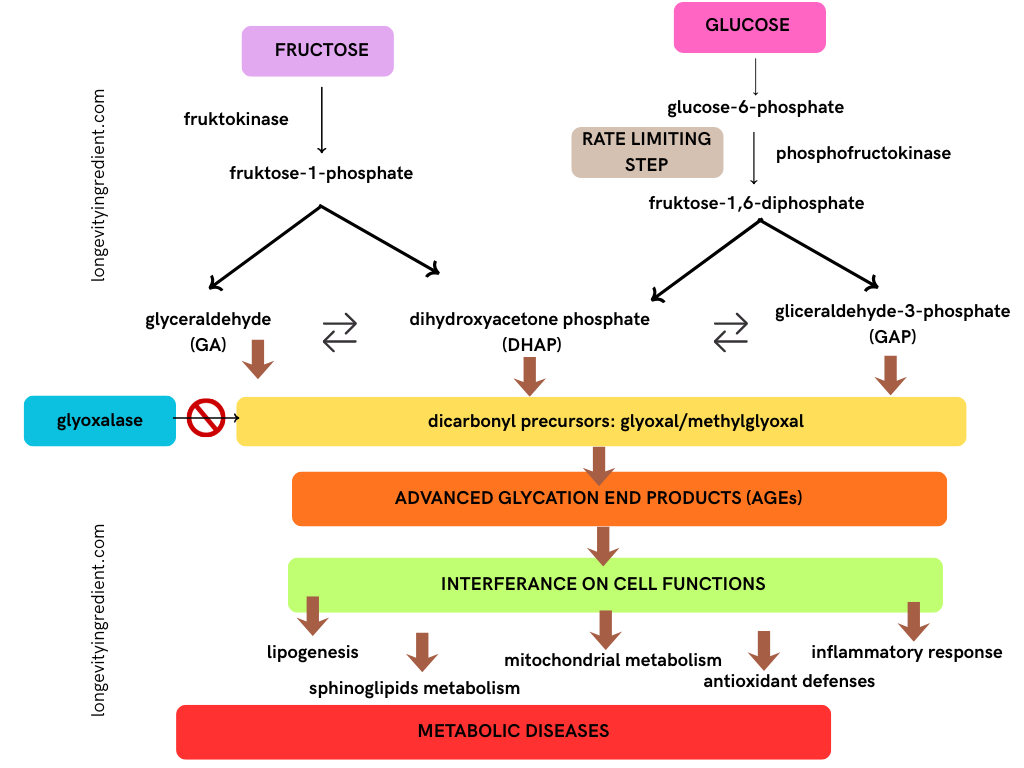
Let’s have a glance at Figure 1, and look into this in a little bit more detail: The body breaks down two sugars, fructose and glucose, in slightly different ways. Eventually, they change into compounds called glyceraldehyde (GA), dihydroxyacetone phosphate (DHAP), and gliceraldehyde-3-phosphate (GAP). And these intermediates can accidentally form harmful chemicals: glyoxal/methylglyoxal, which can attach to proteins, fats, and DNA.
Glyoxalase represents the body’s detoxification system. Its job is to neutralise these reactive chemicals before they cause damage. If those reactive chemicals aren’t removed, they can create Advanced Glycation End Products (AGEs). AGEs accumulation in tissues can interfere with many cell functions (ex. lipogenesis, sphingolipids, and mitochondria metabolism, antioxidant defences, and inflammatory response), contributing to metabolic diseases (Fig. 1) (Arango et al., 2017).
Important side note: cooking methods
AGEs, as shown above, can be endogenously formed as a consequence of a high dietary sugar intake, but also can be ingested with high-temperature processed foods (Aragno et. al., 2017).
The glycation of proteins, known as the Maillard reaction, is the non-enzymic reaction between a protein and a reducing sugar (Gatineau et al., 2017). It occurs when grilling, frying, deep-fat frying, and roasting. It’s well-known that these methods are culprits for producing higher levels of AGEs in food. In contrast, methods of preparation that are water-based, such as boiling and steaming, produce a much lower amount of AGEs. Hence, the existing theory that the relatively youthful appearance, often observed amongst the elderly Asian population, is evidence of the long-term impact of traditionally practising this type of cooking (Nguyen et al., 2015).
So, How About Fruit? Why You Can, and You Still Should Eat Them – Context & Portion-Control Matter
Eating fruit is healthy mainly because it delivers sugar inside a protective package of fibre, water, vitamins, minerals, and antioxidants that support immunity, collagen formation, and cellular repair.
Most of the guidelines usually recommend about 1–2 portions of fruit per day. They should be eaten as a part of a meal paired with a source of protein and healthy fats. It’s important to prevent a glucose spike.
Remember that whole, fresh or frozen fruit (without added sugar) is preferred over juice, because juice form is poor in fibre and makes the sugar hit your bloodstream much faster and stronger (described above as “glucose spike”).
Practical Advice
Limiting both the consumption of AGEs and their internal production through physiological glycation is probably the most effective strategy for limiting the “saggy face” look – the nutritional equivalent of a facelift.
- Try to follow a low-sugar diet prepared through water-based cooking methods.
- Read all the labels – look for hidden sugar.
- Rule of thumb: avoid foods known for higher levels of AGEs, such as processed sweets, sweetened soft drinks, and barbecued and processed meats.
- Challenge yourself: One month, no added sugar – these 30 days can change everything.
References
Daley SF, Masood W, Annamaraju P, et al. The Ketogenic Diet: Clinical Applications, Evidence-based Indications, and Implementation. StatPearls Publishing; 2026 Available from: https://www.ncbi.nlm.nih.gov/books/NBK499830/
Danby FW. Nutrition and aging skin: sugar and glycation. Clin Dermatol. 2010 Jul-Aug;28(4):409-11. doi: 10.1016/j.clindermatol.2010.03.018. PMID: 20620757.
Nguyen HP, Katta R. Sugar Sag: Glycation and the Role of Diet in Aging Skin. Skin Therapy Lett. 2015 Nov;20(6):1-5. PMID: 27224842.
Gatineau E, Polakof S, Dardevet D, Mosoni L. Similarities and interactions between the ageing process and high chronic intake of added sugars. Nutr Res Rev. 2017 Dec;30(2):191-207. doi: 10.1017/S0954422417000051. Epub 2017 May 17. PMID: 28511733.
Aragno M, Mastrocola R. Dietary Sugars and Endogenous Formation of Advanced Glycation Endproducts: Emerging Mechanisms of Disease. Nutrients. 2017 Apr 14;9(4):385. doi: 10.3390/nu9040385. PMID: 28420091; PMCID: PMC5409724.
[…] mentioned in the article about added sugar, boiling and steaming should be the most common way of heat-treating food. Avoid frying, grilling, […]