
While at the beginning of the journey of self-discovery, many people tend to assume that fame and money will make them happy and solve all their problems.
“I think everybody should get rich and famous and do everything they ever dreamed of so they can see that it’s not the answer.” ~Jim Carrey
So then what is the answer we might ask?
In the late 1930’, some researchers had a brilliant idea to actually gather scientific evidence and answer this burning question: „What makes a good life?” The Harvard Study of Adult Development was started in 1939. The goals were to identify „psychosocial variables and biological processes in early life that predict health and well-being in late life, aspects of childhood and adult experience that predict the quality of intimate relationships in late life, and how late life marriage is linked with health and well-being”.
So a hypothesis was born: „Good relationships are the strongest predictor of happiness and health”.
We know as a fact that loneliness is as harmful as smoking or alcoholism. In a way, social isolation and loneliness have more powerful negative effects on health and longevity than we would like to admit.
But it’s important to remember that it’s not so much about how many friends one has and how big one’s family is. It’s a lot about the quality of the relationship. That might be a reason why, as we become more mature, we become more selective in our choices. It’s about how satisfying and supportive the relationships are.
The study has shown that „the quality of close relationships matters more than wealth, fame, or social class in determining long-term wellbeing”.
It has been shown as well that relationship satisfaction at age 50 predicts physical health at age 80: People who were most satisfied in their relationships at midlife were healthiest in their 80s – more so than cholesterol levels or other physical markers.
The relationship doesn’t have to be a romantic one. Marital status alone explains only 2% of one’s subjective well-being. The role of marital satisfaction in physical health was determined by contrasting this protective role with the absence of any moderating influence by time spent with others. We know that the same result can be achieved with friendship or even meaningful acquaintances.
Nevertheless, for those who are happily married, marital satisfaction buffers against health decline: For both men and women, higher marital satisfaction protects daily happiness from fluctuations in perceived physical health (Waldinger et al., 2010).
According to the Canadian Psychological Association, “attachment is a special emotional relationship between two people, with an expectation of protection“. Attachment style plays a key role in relationship satisfaction. A useful reference on this topic is the systematic review by Eilert and Buchheim, “Attachment-Related Differences in Emotion Regulation in Adults.” In this research, many different classifications have been presented. Nonetheless, for this article, I decided to divide it into three main styles: secure, insecure, and unresolved.
Secure attachment is linked to balanced emotion regulation, while insecure attachment shows impairments and unresolved attachment is associated with dysfunctional regulation.
Research shows that secure attachment is connected to lower levels of loneliness and a stronger sense of social connection. It provides a foundation for forming fulfilling relationships and maintaining a sense of connection, even when alone.
In contrast, in insecure attachment individuals tend to turn a state of solitude into an experience of loneliness. In the long run, it is associated with harmful effects on the perceived stability and quality of interpersonal relationships (Eilert & Buchheim, 2023).
Secure attachment in late life promotes cognitive and emotional well-being: Greater security in spousal relationships is linked with better memory, less depression, greater life satisfaction, and better mood over time (Waldinger et al., 2015).
We see it not only in movies, but also amongst our friends, and eventually we see it for ourselves. Even while having lots of success and money, but also while not having it at all… It’s our mental health, sense of belonging to the community, feeling needed and loved that will determine whether we are truly happy. Money and success can help with greater comfort, better health and more fun, but they don’t guarantee happiness. I know it might sound like the morals from Paulo Coelho’s pieces, but it’s been backed by scientific data in large-scale studies.
So it’s not my intention to say here that good relationships will save us from health problems for good, but we tend to underestimate their role. Healing the mind is equally important to healing the body, and one can not work without the other.
Of course, the problem with these types of studies is that, like in most epidemiological research, the data are mostly self-reported. In consequence, there is a certain uncertainty about the reliability and the validity of the results. Nevertheless, studies conducted in this area are coming to similar conclusions.
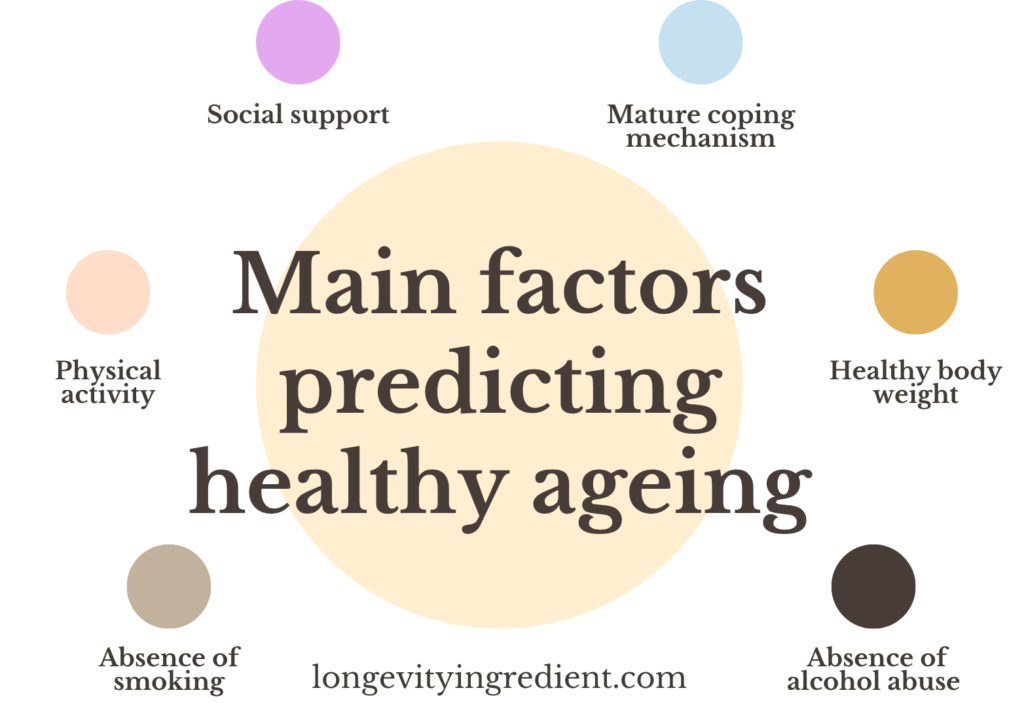
Oftentimes mentioned factors that predict healthy ageing are physical activity, absence of smoking and alcohol abuse, healthy body weight and social support (Bones et al., 2019). In the book “Aging Well: Surprising Guideposts to a Happier Life from the Landmark Harvard Study of Adult Development“, George E. Vaillant also mentions the importance of having mature mechanisms to cope with life’s ups and downs.
Social support and healthy coping mechanisms influence health hand in hand. Talking with a trusted friend or family member, volunteering or helping others are just a few of many mechanisms that help individuals cope with stress.
References:
Mineo, L., & Mineo, L. (2024, January 11). Good genes are nice, but joy is better. Harvard Gazette. https://news.harvard.edu/gazette/story/2017/04/over-nearly-80-years-harvard-study-has-been-showing-how-to-live-a-healthy-and-happy-life/
The Good Life. An interview with Robert Waldinger (2025, March 14). Harvard Medicine Magazine. https://magazine.hms.harvard.edu/articles/good-life
The Good Life by Robert Waldinger, MD, and Marc Schulz, PhD, published by Simon and Schuster. Copyright 2023
Waldinger RJ, Schulz MS. What’s love got to do with it? Social functioning, perceived health, and daily happiness in married octogenarians. Psychol Aging. 2010 Jun;25(2):422-31. doi: 10.1037/a0019087. PMID: 20545426; PMCID: PMC2896234.
Eilert, D.W.; Buchheim, A. Attachment-Related Differences in Emotion Regulation in Adults: A Systematic Review on Attachment Representations. Brain Sci. 2023, 13, 884. https://doi.org/10.3390/brainsci13060884
Waldinger RJ, Cohen S, Schulz MS, Crowell JA. Security of attachment to spouses in late life: Concurrent and prospective links with cognitive and emotional wellbeing. Clin Psychol Sci. 2015 Jun 1;3(4):516-529. doi: 10.1177/2167702614541261. PMID: 26413428; PMCID: PMC4579537.
Bosnes I, Nordahl HM, Stordal E, Bosnes O, Myklebust TÅ, Almkvist O. Lifestyle predictors of successful aging: A 20-year prospective HUNT study. PLoS One. 2019 Jul 11;14(7):e0219200. doi: 10.1371/journal.pone.0219200. PMID: 31295289; PMCID: PMC6622492.




Be First to Comment